Finding decaying timber can be a worrying occurrence, especially if you notice bouncing floorboards or a persistent musty odour in the home.
Homes across the United Kingdom are typically built using timber, forming everything from the floorboards and joists beneath your carpets to the heavy rafters holding up your roof.
When timbers become damp and the moisture content increases, it opens the door to fungal decay.
Many homeowners, landlords, and commercial contractors get in touch with our surveyors asking a fundamental query: Is wood rot serious?
The short answer is yes.
If left untreated, wood rot degrades the structural stability of timber, and over time this can lead to weakened timbers which run the risk of collapse.
Catching a fungal decay problem early and stopping the moisture source that is the root cause of the issue will help avoid timber failure and prevent more costly timber repairs.
This guide will explain what causes wood rot, how to spot the early warning signs, and the practical steps you need to take to treat the problem and protect your property long-term.
Understanding Wood Rot and How It Occurs
Wood rot does not appear at random; it is a biological process caused when the moisture content of timber is increased.
The lifecycle of wood rot begins with microscopic airborne spores that are constantly circulating in the atmosphere. In a dry, well-ventilated property, these spores are completely harmless. However, when these airborne spores land on damp wood with an elevated moisture content, they germinate.
The germinating spores sprout fine, root-like threads called hyphae, in the same way that bread mould spreads. These threads secrete specific enzymes that digest the cellulose within the wood if a brown rot or the cellulose and lignin if a white rot. These are the organic compounds that provide wood with its physical strength, density, and rigidity.
Optimal Conditions for Wood Rot
For the destructive fungus to grow and propagate, it requires specific environmental conditions:
Elevated Moisture Content: For wood rot to occur, there must be a source of moisture, typically caused by a building defect, damp masonry in contact with timber, or an underlying leak. Levels above 18% wood moisture content put timber at risk of decay. Optimal growth levels for dry rot are 30 – 40% moisture content (Fibre saturation point) and 22ºC. Whilst wet rots thrive at 50 – 60% moisture content and at a range of temperatures.
Poor Ventilation: Stagnant, unventilated air spaces that prevent damp wood from drying out naturally.
A Source of Wood: Untreated timber in contact with moisture will provide the nutrients for wood rot to occur.
What Does Wood Rot Look Like? Early Signs & Warning Indicators
To minimise the spread of an outbreak, it is essential to recognise the first signs of wood rot. Catching the issue as soon as possible will prevent further damage.
Fungal decay generally falls into two distinct categories: Brown rot and white rot.
Understanding the difference between dry rot (Brown) and wet rot (Brown or White) is vital because they require different treatments.
First Signs of Wet Rot
There are many species of wet rots, and these are the ‘toadstools’ you see in woodland or fields. For that reason, wet rot is the more common of the two types and requires higher moisture levels compared to dry rot. It remains strictly localised to timber in an area where an active water source is present. Look out for:
- Soft, Rotten Wood: The wood loses its natural density and feels soft or spongy when pressed firmly.
- Localised Peeling Paint: Paint or varnish layers on the surface will bubble, crack, or flake away. This is common on skirting boards caused by either condensation running down the walls, or rising damp causing the masonry within the wall to become damp.
- Timber Discolouration: With brown rot, the wood visibly darkens, turning a deep brown or black color beneath any failed paint coatings, whereas with white rot the wood becomes bleached and fibrous.
- Localised Structural Softening: The timber begins to crack, fracture, or crumble away directly along the wet, saturated zone.
First Signs of Dry Rot
Dry rot (Serpula lacrymans) is a far more aggressive, complex, and serious fungus. While it needs a foothold of moisture to get started, it can spread its mycelium and root-like strands through thick masonry, brickwork, and plaster to infect completely dry timbers in other parts of the property. Key indicators include:
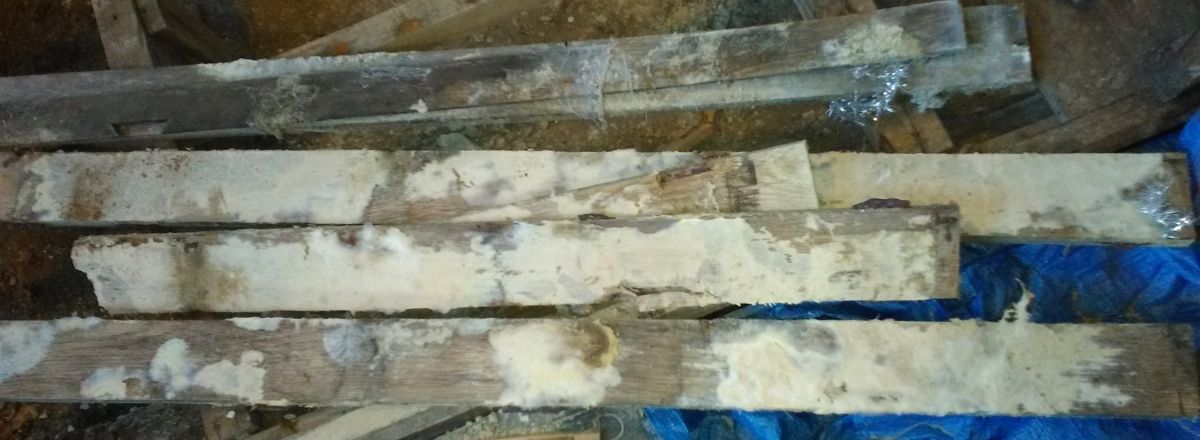
- Grey ‘velvet’ mat or white cotton wool-like mycelium: Where there is some ventilation, the fungus spreads as a grey mat with lilac patches, but where ventilation is lacking, if can form masses of white cotton wool-like growth with sulphur yellow patches.
- Strands Traveling Across Masonry: Tough, vein-like grey strands spread across bare brickwork or under floorboards, pulling water from the damp zone to feed the decay front.
- Rust-Red Spore Dust: An active dry rot outbreak distributes millions of microscopic spores from the surface of the sporophore, coating surrounding ledges and floors in a fine, reddish-brown or rust-coloured dust layer.
- Mushroom-Like Fruiting Bodies: Flat, fleshy, pancake-like fruiting structures form in gaps above skirting boards or floorboards. These sporophores feature a deeply wrinkled, rust-orange centre with bright white edges.
- Deep Cuboidal Cracking: The timber shrinks rapidly, darkens, and cracks both across and along the grain, splitting the wood into distinct, brittle, cube-like sections that effortlessly crumble into powder when touched.
What to Do When You Find Rotting Wood in Your House?
Discovering damaged timber requires a calm, systematic response to ensure the problem is managed correctly. Take these immediate steps:
1. Stop the Moisture Source Immediately
Fungi cannot survive or spread without a continuous supply of moisture. Wiping away the fungal growth or applying DIY treatments will not work unless the underlying moisture source is tackled. You must look for common structural defects, such as :
- Leaking or damaged roof coverings and slipped slates or tiles.
- Blocked, broken, or overflowing external gutters and downpipes.
- Hidden plumbing leaks from internal pipes, radiators, or appliances.
- Penetrating damp through porous masonry, cracked external rendering, or around window frames.
- Failed or bridged damp proof courses (DPCs) resulting in rising damp.
2. Investigate the Extent of Damage
Once you believe the moisture has been stopped, you need to gauge the extent of the timber decay. A simple practical test is to push a small sharp screwdriver firmly into the surface of the suspect timber. If the metal tip sinks easily into the wood with little resistance, or if the timber hollowly splinters and crumbles away, the structural integrity of the wood has been compromised, and repair or replacement will be necessary.
3. Book a Professional Survey
Because fungal decay can often remain hidden out of sight in subfloor voids, within wall cavities, beneath floorboards, and deep within dark ceiling spaces, the visible damage on your skirting boards is rarely the full picture. It may be necessary to undertake exposure work to identify the extent of the infection and ensure report accuracy.
Booking a professional damp and timber survey provides definitive answers, accurately identifying the full extent of the problem and the source of moisture causing the issue.
Wet Rot Treatment Options
Once a qualified specialist has accurately diagnosed the issue as wet rot, repairs can safely begin.
Treating wood affected by wet rot typically involves:
- Isolate and Repair the Leak: Completely fix the structural defect, damp problem, or plumbing leak providing the source of moisture.
- Dry the Structure: Allow the remaining timber and masonry walls to thoroughly dry out.
- Apply Wood Preservatives: Treat the remaining adjacent timber with fungicidal products to kill any lingering spores and protect the wood during the drying phase.
- Reinforce or Replace Timber: Any timber section that has completely lost its load-bearing capacity must be cut away and replaced with new timber, or reinforced using specialised steel plates or timber splices.
- Long-Term Peace of Mind: Typically, wet rot treatments carried out by Rentokil Property Care are protected with our 30-year guarantee, giving you confidence the wet rot problem is solved for good.
DIY vs. Professional Treatment
A competent homeowner or landlord can often handle localised DIY wet rot treatments on non-structural items, such as a rotten external windowsill, a decorative door frame, or a minor section of skirting board.
However, if the wet rot has compromised vital structural components, such as your structural floor joists, main roof timbers, or load-bearing wall plates, DIY attempts are more risky.
These structural repairs often require professional assistance in order to guarantee the ongoing safety and stability of the property.
Dry Rot Treatment Options
Because of the aggressive way Dry Rot spreads its root-like strands through walls and plasterwork, dry rot is highly complex and requires specialist eradication. At the survey stage, it may be necessary to undertake exposure work to identify the extent of the infection.
To successfully eliminate an active dry rot outbreak, experienced technicians will typically carry out the following repairs:
- Identify and Isolate Moisture: Find and permanently fix the moisture source feeding the outbreak.
- Cut Back Infected Timbers: Because the fungus can travel inside wood fibers before showing external cuboidal cracks, structural timbers will be cut back beyond the last visible sign of fungal decay.
- Sterilise the Surrounding Masonry: All plasterwork within the infected zone must be removed to expose the bare wall structure if timber elements are present. Technicians then wire brush the surface to remove mycelium and treat the masonry using a targeted fungicide to kill any buried spores or mycelium.
- Reinstall with Pre-Treated Wood: All replacement structural timbers are either industrial pre-treated or sprayed/pasted on site with advanced fungicidal preservatives. All timbers are isolated from the masonry using waterproof membranes to remove the risk of becoming damp in the future.
- Long-Term Peace of Mind: Typically, dry rot treatments carried out by Rentokil Property Care are protected with our 30-year guarantee. This gives you the confidence that your property is protected.
Can a House Be Saved from Dry Rot?
It is completely normal for a property owner to be concerned when finding dry rot in their property. However, there are reliable and long-term treatments that will prevent dry rot, whilst returning the property to its original condition, often backed by guarantees for added protection.
No matter how severe or extensive the dry rot outbreak appears, it is entirely treatable and controllable when correctly identified and managed by a specialist.
While an advanced outbreak requires extensive remedial work, a professional, systematic approach will completely eradicate the fungus, replace the damaged timber fabric, and fully restore the structural safety of your home.
The only issues that can occur are when the moisture and infection source is within a party wall or adjacent property, and the owner will not address the issue. This can make a long-term resolution very difficult.
Steps to Prevent Wood Rot from Returning
Once your property has been successfully cleared of fungal decay, or to prevent wood rot from occurring in the future, carrying out regular maintenance is key to preventing the damp conditions required for fungal spores to germinate.
- Routine Roof Inspections: Inspect your roof slates, lead valleys, and chimney flashing regularly to catch defects before rain can enter the loft space.
- Clear Guttering Paths: Regularly clear away leaves, moss, and silt from your external gutters, hoppers, and downpipes to avoid overflows that saturate external brickwork.
- Under-Floor Airflow: Ensure your external sub-floor air bricks are kept clean, unblocked, and free from soil or garden plants to maintain a continuous cross-flow of fresh air under suspended floor joists. It is also important that there is sufficient space between the floor timbers and the soil or concrete sub-floor to ensure free airflow and prevent moisture tracking.
- Protect Exterior Timber: Regularly recoat external window casings, doors, and fascia boards using professional weather-resistant coatings or wood preservatives to block water entry.
- Internal Ventilation: Condensation can cause wet rot, so improvements to internal ventilation in moisture-producing rooms such as kitchens and bathrooms will prevent excess moisture condensing on walls and rotting skirting boards.
How Rentokil Property Care Can Help
If you are worried about wood rot in your property, Rentokil Property Care has a number of qualified surveyors operating from our local branches across the country. Our remediation treatments are detailed, compliant, and backed by our industry-trusted guarantees for long-term peace of mind.
Typically, our wood rot treatments are backed by long-term guarantees, giving you the peace of mind that your property is protected over the next 30 years.
Conclusion
Discovering rotting wood in your house should never be ignored or left to a temporary cosmetic coat of paint.
Wood rot can silently destroy your property’s structural timber if left untreated. However, catching the issue early allows you to fix the underlying moisture source, execute targeted repairs, and keep your property safe and secure for the long term.
Worried about decaying timber? Book a professional survey with Rentokil Property Care today to secure a long-term solution.