Why are insects attracted to light?
The real reason insects are attracted to light
For thousands of years, humans have watched nocturnal flying insects swarm around fires and lamps. This led ancient cultures to adapt this phenomenon to control some insect pests. Roman records describe beekeepers using oil lamps at night to attract and capture wax moths to protect their hives from destruction. By the 16th century, European apiarists were using nearly identical light traps and, in 1847, one of the earliest US patents was granted for an illuminated beehive trap designed to protect against insect pests.
Although insect light traps (ILTs) have been used for centuries, scientists have long been puzzled by the biological mechanisms that attract insects to artificial light and make them circle it. Now, using high-speed photography, they believe they have identified those mechanisms.
To a layperson, asking why insects circle lamps may seem like an academic exercise. But for commercial businesses, particularly those in food manufacturing, hospitality, pharmaceutical manufacturing, and retail, understanding this behaviour is vital to preventing insect infestations, product contamination and the spread of pathogens, as well as protecting their brand reputation.
How insects see light
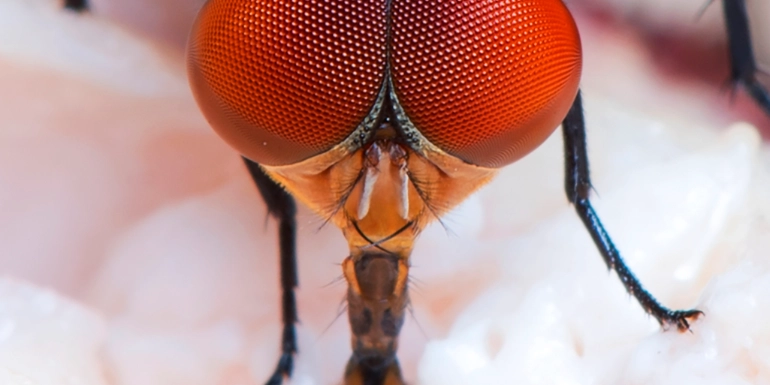
An insect's view of the world is dramatically different from ours. They have specialised compound eyes, unique photoreceptors, and distinct sensory organs. Insects also possess intricate visual systems that govern how they perceive motion, detect colours, navigate in the dark and respond to surrounding light sources.
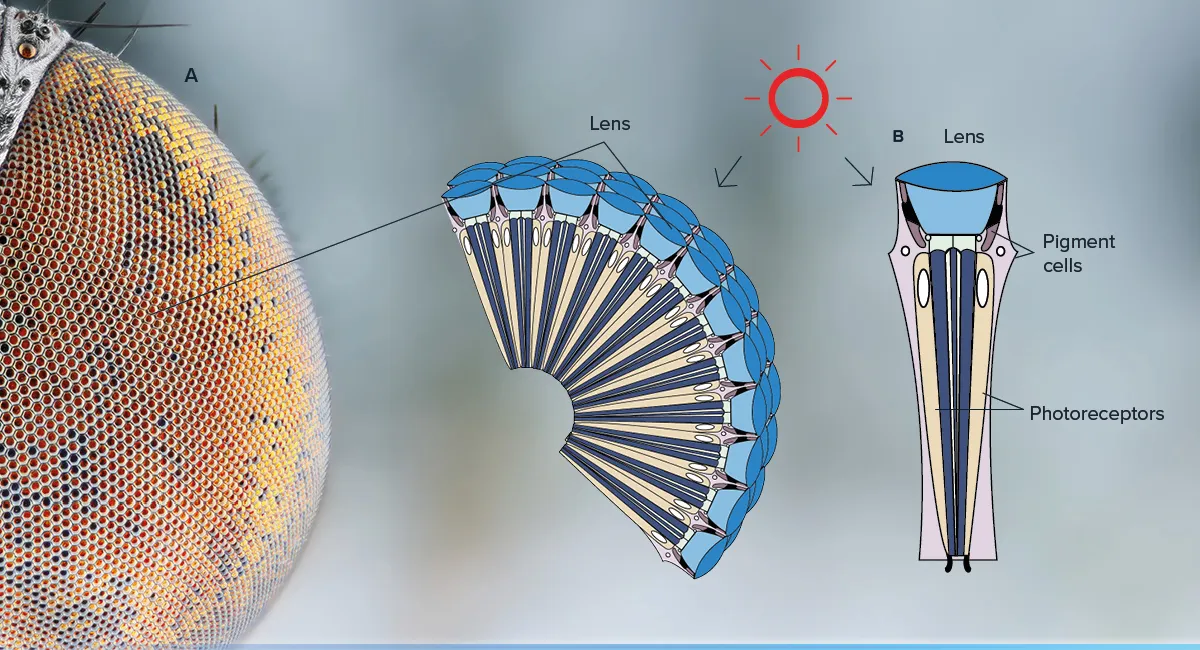 The structure of the ommatidia in a compound insect eye
Primary vision systems: compound eyes
Most adult insects have compound eyes, one on either side of their head, consisting of 100s to 1000s of tiny, elongated, hexagonal cells called ommatidia. Each one collects a simple image from a small angle of view, and when they are combined in the insect’s brain, they form a mosaic-like image across a wide angle of vision.
Colour and ultraviolet (UV) detection
Different species of insect have from one (e.g. Heliconius butterflies, Aedes albopictus mosquito) to 15 (e.g. the butterfly Graphium sarpedon) types of colour photoreceptors in their ommatidia, detecting different ranges of wavelengths of light. Some butterfly species can detect up to 10 colour ranges, with peaks of sensitivity spread across the spectrum from near-UV light to red. This means some of the photoreceptors in those with 15 could be redundant or detect the same wavelengths, but also could have other functions, such as detecting different intensities.
Common food pests, house flies (Musca domestica) and fruit flies (Drosophila melanogaster), have five colour photoreceptors, with two detecting near-UV (UVA) and one each for blue, cyan and green wavelengths.
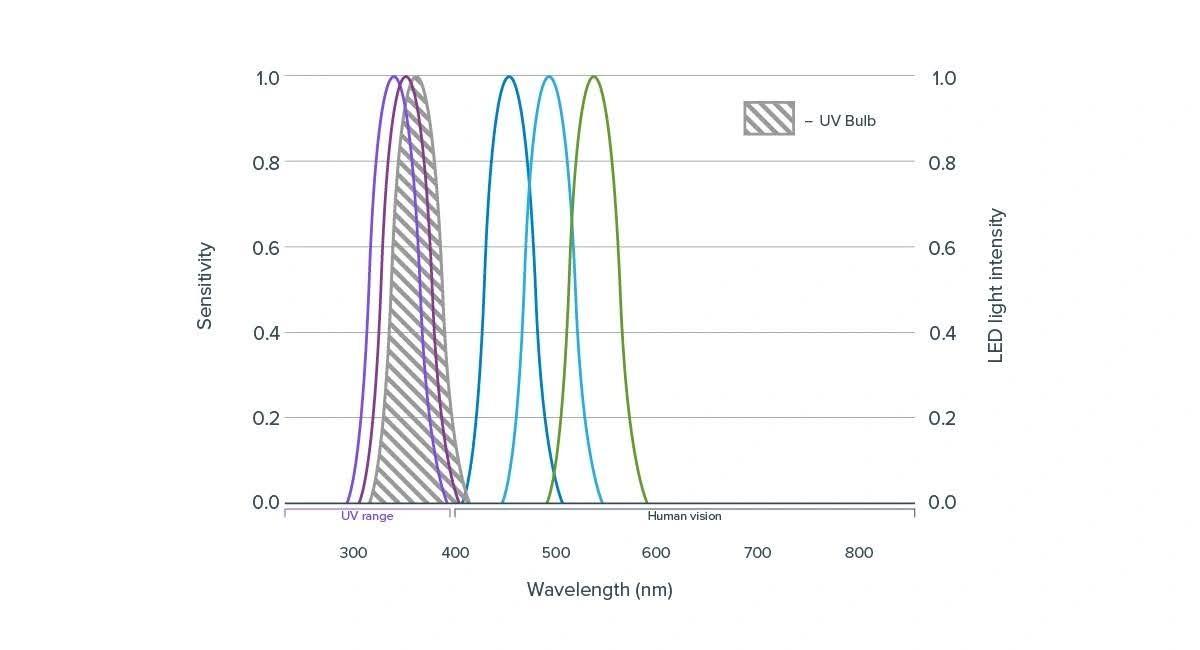 Wavelengths detected by the house fly eye compared to the UV output of Lumnia UV LED bulbs.
Attraction to UV more than visible light
Insects with UV vision are more attracted to UV light than visible light due to specialised neural circuits that help them avoid danger.
1. The open-space response
In natural environments, daylight and skylight contain high proportions of UV radiation. Flying insects have evolved to associate strong UV signals with the open sky or gaps in vegetation. Known as the open-space response, it causes insects to fly toward bright, UV-rich open spaces to escape dense foliage or dark or enclosed spaces where predators may be hiding.
2. Preference for UV is hardwired in the brain
The preference for UV light over visible wavelengths is wired into the insect brain. The mechanism in the fruit fly (Drosophila sp.) was found to be:
- Dedicated UV photoreceptors: Insects possess specialised photoreceptors tuned specifically to UVA light.
- Pooling optical signals: In the medulla region of the brain, a specialised type of nerve cell (called the Dm8 amacrine neuron) receives input from 13 to 16 neighbouring UV-A-sensing photoreceptors. Pooling inputs gives insects high sensitivity to UV-A light against bright visible-light backgrounds, although at the expense of image resolution.
- Driving UV phototaxis: Signals from the Dm8 neurons are sent to visual centres in the brain that govern movement and flight direction. These signals give insects a preference for moving toward UV light (positive phototaxis) rather than toward visible wavelengths.
Chitin UV absorption
The lenses in insect compound eyes, which are composed mainly of chitin, absorb far-UV light (UV-B and C), so the spectral sensitivity of insect eyes becomes minimal near 300 nm and shorter wavelengths. This helps make insect light traps safer for humans, with the more damaging UV-B wavelengths not needed to attract insects.
Motion Detection
Insect eyes are highly adapted to detecting movement. The thousands of ommatidia arranged over a wide angle allow the detection of movement all around the insect. Combined with neural circuits in the insect brain that process visual information from the ommatidia at a high frame rate, this ability gives insects quicker reactions to movement than humans.
Nocturnal adaptations
The eyes of nocturnal Insects are also highly adapted to night vision. Their eyes sacrifice detail for light sensitivity, enabled by their ability to capture and process photons more efficiently. To navigate with so little light, they rely on specific physical and neural adaptations:
- Highly sensitive light detectors: The light-detecting cells in night-active insects are up to five times more sensitive than those in daytime insects, helping them boost low levels of light.
- Spatial neural summation: Visual neural circuits in the lamina combine signals from around 100 neighbouring ommatidial cartridges, boosting light sensitivity, but decreasing resolution.
- Temporal neural summation: Optical processing integrates photons over longer periods, boosting contrast sensitivity up to 100-fold.
These enable nocturnal insects to manoeuvre in complex surroundings and distinguish colours at night at light levels that would appear dark to humans. They can also analyse the pattern of polarised light around the moon for navigation.
However, the sensitivity to low light levels also makes nocturnal insects vulnerable to artificial light sources. When they fly near an electric light bulb, their eyes are overwhelmed by the intense light, causing disorientation. This also means that bright light at night is not necessary to capture nocturnal insect pests in ILTs.
Secondary vision and navigation systems
Insects also have several other light-sensitive cells.
- Ocelli: These are simple eyes found in many adult insects, usually on the top or front of the head. They do not form an image but sense the brightness and direction of light. They are thought to help insects maintain flight stability and navigate using the sun’s position.
- Polarisation-sensitive photoreceptors: These are found in some ommatidia of insects in the dorsal or ventral regions of their eyes. They are specialised for detecting skylight, distinguishing it from reflected light and helping insects orient themselves and navigate using the sky's polarisation pattern.
- Extra-Ocular Photoreceptors: These are light-sensitive cells located on other parts of the insect body, such as the antennae, abdomen or legs. They sense the intensity and wavelength of light and are believed to play a role in regulating circadian rhythms and body temperature.
How the dorsal light response explains insect behaviour
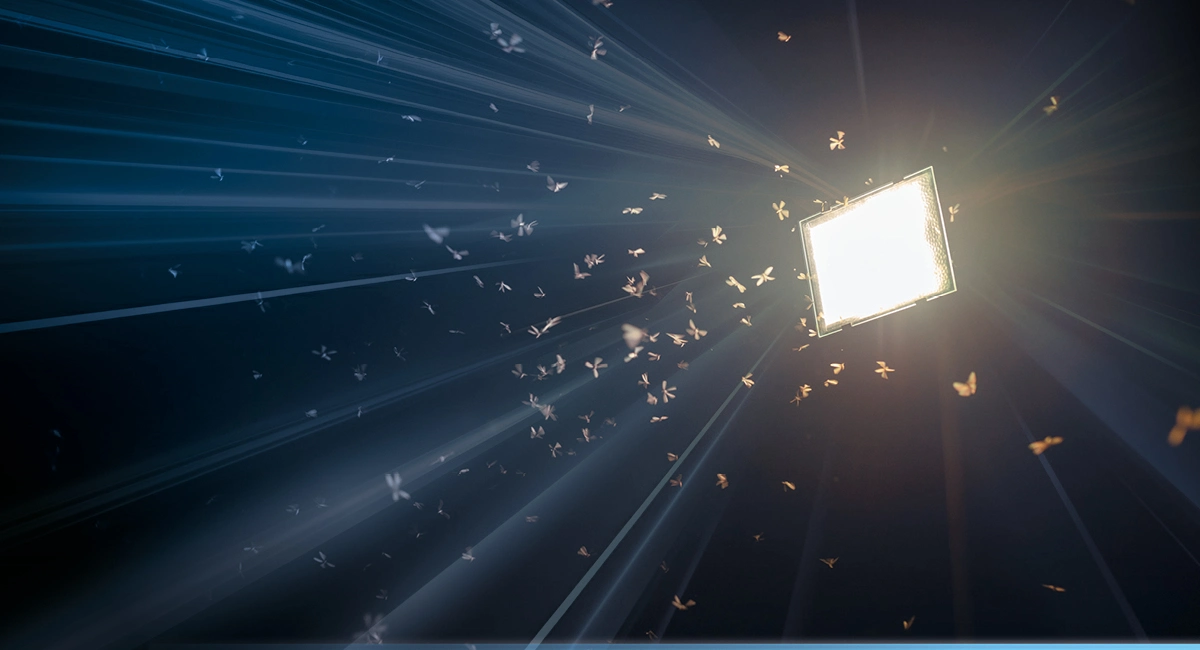 Insects swarm around a bright light emitting rays in a dark space.
Over the centuries, there have been several competing explanations for why flying insects are attracted to artificial light sources, including: the lamp's heat, escape responses (mistaking the light for a bright open space), and lunar navigation (maintaining a fixed angle relative to their usual light source, the moon).
Research published in the journal Nature in 2024 used high-speed 3D stereo-videography and infrared motion capture to decode how insects fly around artificial light. The study showed that insects are rarely drawn to artificial light from long distances. Instead, when an insect enters a lamp’s immediate vicinity, the point light source hijacks its dorsal light response (DLR), an ancient evolutionary reflex.
Nocturnal insects have evolved with the moon and stars as the brightest objects at night. To maintain level flight, insects keep their dorsal (top) side oriented upwards, toward these celestial bodies. Around artificial lights, according to the study, this orientation reflex misfires as a result of two mechanisms:
- Orthogonal circling: When flying past a lamp, insects tilt their backs toward the light. This results in them flying at right angles (orthogonally) to the beam, trapping them in circular orbits.
- Stalling and inversion (tumbling): If insects fly directly over a bulb, they tilt backwards to orient towards the light, causing a steep climb, stall and loss of lift. If light shines from beneath them, they flip upside down and crash to the floor.
The nuptial flight hypothesis
Scientists have proposed that orientation to a light source evolved as an adaptive strategy during nocturnal nuptial flights to synchronise the flight paths of insects seeking mates. It increases the likelihood of insects encountering one another as they fly across open landscapes. Artificial lamps disrupt this navigation system, turning a vital reproductive strategy into a trap.
Summary of traditional assumptions vs recent findings of how insects are attracted to light
| Explanation for attraction to light | Traditional assumption | New study findings |
|---|---|---|
| Long-distance pull | Insects are actively drawn to light sources from hundreds of metres away. | Insects do not fly toward distant light; they become disoriented and trapped only when entering its immediate proximity. |
| Flight trajectory | Insects deliberately fly straight into the bulb or fly in intentional spirals. | Insects keep their back (dorsum) toward the bulb via the dorsal light response (DLR), forcing orthogonal circling, stalling or upside-down tumbling. |
| Thermal attraction | Insects seek thermal infrared heat emitted by hot lamp filaments. | Thermal heat plays no role; cool UV-LEDs emit minimal radiant heat while efficiently trapping flying pests. |
| Biological driver | Light attraction is a simple sensory error or accidental escape reaction. | Lamps disrupt DLR flight stability reflexes, hijack Dm8 UV neural circuits, and break celestial nuptial flight alignment. |
How to reduce the impact of external lighting on insect ecosystems
 Illuminated industrial refinery towers standing against a deep blue dusk sky.
While indoor UV-LED traps are essential for pest management, unshielded outdoor commercial lighting disrupts the life cycles of nocturnal insects and other animals (and upsets astronomers). Businesses can help protect surrounding ecosystems and also reduce the attraction of insects towards their buildings by practising evidence-based lighting principles:
- Remove unnecessary lights: Turning off or completely removing non-essential outdoor light sources is the most effective method.
- Directional and shielded fixtures: Use fixtures that direct light downward onto target areas (such as pathways) while preventing upwelling and lateral spill onto surrounding vegetation or water. Using directional lighting instead of diffuse fixtures also reduces insect attraction.
- Motion activators: Install motion sensors so that outdoor lighting activates only when human movement is detected.
Two common practices to reduce the impact of lighting were found to have little actual impact:
- Dimming: It is generally ineffective for most nocturnal insects because they are highly sensitive to low light levels. Even severely dimmed artificial light (below 5 lux) continues to trigger flight-to-light behaviour and disrupts moth feeding and diapause.
- Warm white LEDs: Changing from cool white to warm white LEDs results in little to no measurable reduction in insect attraction, largely because the warm white LEDs emit similar amounts of blue light.
From science to solution: how Lumnia optimises insect trapping
Understanding insect UV vision and behaviour directly informed the development of a better insect trap. The Lumnia insect light traps (ILTs) represented a quantum leap forward from legacy electric fly killers (EFKs) when they were first launched in 2016.
Precision UV-LED spectral output
Traditional EFKs use relatively high-wattage fluorescent tubes, wasting significant energy as heat and in emitting some visible and UV-B wavelengths that don’t attract pest insects. Lumnia uses high-quality UV LEDs tuned specifically to the 350–370 nm UV-A range to which house flies and fruit flies are most visually sensitive.
Energy efficiency
Lumnia units reduce energy consumption by up to 62% compared to traditional EFKs by replacing fluorescent tubes with UV-LEDs, while improving fly capture rates. Lumnia also has an adaptive power mode that automatically dims LED brightness at night when there is no competing light, saving energy.
Encapsulation instead of electrocution
Old-style electric fly killers electrocute insects when they fly into a wire grid, causing their bodies to explode and scatter fragments. In commercial kitchens and food-manufacturing plants, these fragments can contaminate food products and surfaces near the units. Lumnia ILTs use glue boards to capture intact insect bodies, preventing the scattering of fly fragments. They also allow monitoring of the insect species and the number captured.
Turning fly vision science into commercial pest control
Lumnia UV LED insect traps efficiently attract and trap insect pests, helping food preparation businesses maintain hygiene standards, meet food safety regulations and lower energy costs
FAQs
Insects use bright light sources from above, like the moon, to keep themselves flying level. Artificial lights confuse their sense of up and down, causing insects to tilt towards the light source and get trapped in continuous circular flight paths or crash towards the ground.
No, insects are generally not drawn to artificial lights from long distances. Instead, light disorients and traps them only when they happen to fly close to it.
Flies have specialised photoreceptors in their compound eyes that are naturally sensitive to UV light. Flying towards UV light helps them navigate toward open space, making UV insect light traps particularly attractive to pest insects.
Heat does not play a role in attracting insects to a light. Modern cool-operating UV-LED traps are just as effective as the hotter fluorescent UV bulbs, and far more effective than the incandescent bulbs and flames used in very early insect killers.
Dimming lights or switching to warm white LEDs offers little help. Insect eyes are extremely sensitive even to very low light levels, and warm white LEDs still emit blue light wavelengths that attract bugs.