Call to Book a Survey +448083018423 or Contact Us Online
Woodworm and Woodboring Beetle Species
Tiny woodworm holes on timber beams in old houses, across historic buildings and even on antique furniture are one of the most recognisable ways to identify woodworm, but many may not realise that there are many different species of woodworm that can affect timber differently.
If left, an active woodworm infestation can cause severe damage to timber throughout a property, and there are several species of woodworm beetles in the UK. Some will cause more damage than others and each have variations in lifecycle, preferred timbers they infest and extent of damage they can cause.
Woodworm are actually the larvae of woodboring beetles, and it is their tunnelling within the timber that causes the most amount of damage. Spotting the signs of woodworm damage can help identify an active infestation, and may prevent costly repairs in the future.
Rentokil Property Care have put together a guide on the most common woodworm species found in the UK, and how different types of woodworm can cause varying levels of damage.
We have been dealing with woodworm infestations in homes and businesses for decades, so if you are worried about a woodworm problem we are here to help. Rentokil Property Care have a number of CSRT and CSTDB qualified surveyors who are experts in identifying woodworm, and will provide you with detailed recommendations for treatments, if required.
Common Types of Woodworm in the UK
As woodworm is the general name for the larvae of different woodboring beetles, it covers numerous species. The most common type of woodboring beetle that affects properties in the United Kingdom is the Common Furniture Beetle, which is estimated to account for as much as 80% of all woodworm damage in homes every year.
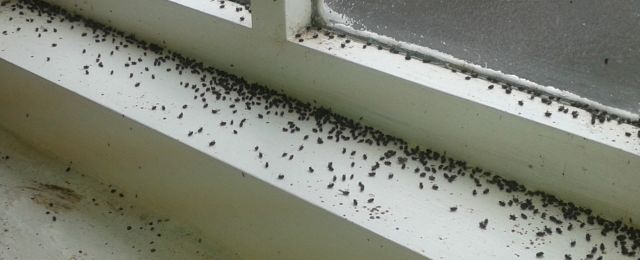
The adult beetle will usually emerge between April and September, and is visible with the naked eye. They are often spotted on window sills as they fly towards the sunlight. The differing lifecycles, diameter of tunnels and favoured timber means that identification is essential when investigating woodworm problems.
If you have spotted woodworm in your property it could mean you have an active infestation that may require specialist treatment. If you are unsure about the next steps, a professional damp and timber survey from a qualified surveyor can help provide answers.
Common Furniture Beetle
The Common Furniture Beetle (Anobium punctatum) is the most common type of woodworm in the UK. Every year it is responsible for 80% of all woodboring beetle damage in homes. This woodboring beetle is chocolate brown and has wings hidden under protective wing cases (elytra). The adult beetle is between 2.5-4.5mm in length and will leave a 2mm diameter flight hole in timber.
These wood boring beetles consume hardwoods and softwoods, with the sapwood band in particular being severely decayed. The sapwood band was the growing wood in the standing tree, and is full of nutrients and pale in colour compared to the heartwood.
Despite its common name it can cause damage to decorative timber, structural timber and wooden stored goods. It is often brought into a property in furniture, and this is where it's most commonly sighted.
They are however often found in old stumps in hedgerows and will fly into homes during summer, when windows and doors are left open or through roof voids in a terrace house. Adult females will lay eggs on the rough surface of timber on cracks and fissures, beginning the lifecycle.
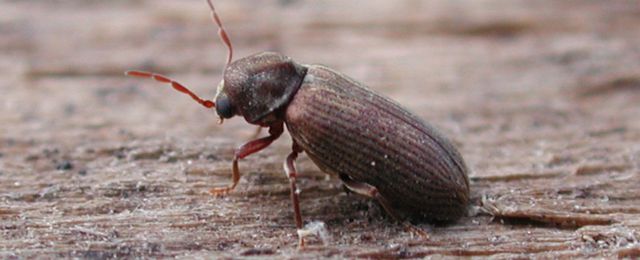
Common Furniture Beetle Lifecycle
Larvae will live for between 3 and 5 years, whilst tunnelling inside timber before emerging as an adult to breed. These wood boring beetles consume hardwoods and softwoods, but the sapwood band is more severely affected, unless the heartwood is damp and decayed.
Once fully grown, the larvae will pupate, before the adult beetle emerges through an exit hole in order to find a mate. The adult female beetle will lay up to 50 eggs in small groups of one to four on the rough surfaces of untreated timbers, ideally in cracks and crevices. Common furniture beetles will not lay eggs on smooth painted or varnished surfaces.
The adult beetles are often found on window sills during the summer months, as they instinctively fly towards light. If you find these in your home you could have an active woodworm problem.

Common furniture beetles can emerge from small exit holes, often surrounded by clean frass, which indicates an active infestation.
Deathwatch Beetle
The Deathwatch beetle (Xestobium rufovillosum) is possibly the most damaging wood borer. It is native to Britain and Deathwatch Beetle has been written about since the early 1600’s. It prefers to infest hardwoods such as seasoned oak, ash or sweet chestnut which have been softened by fungal decay, meaning it is found mostly in historic buildings. Softwoods can be affected if they are affixed to infested hardwoods.
Death watch beetles are grey-brown in colour, and have patches of pale yellow hair on the wing cases. They measure 5-7mm in length. They are commonly found in England as far north as Cumbria and the North East, and are rarely found in Scotland or Ireland.
Often identified by its tapping sound, as the adult beetle bangs the front of its head rapidly on the timber surface. This is done to communicate with other beetles and in particular to attract a mate.
The name derives from occupants of sick rooms (on death watch) who heard this tapping, and associated this sound with being an omen of impending death.
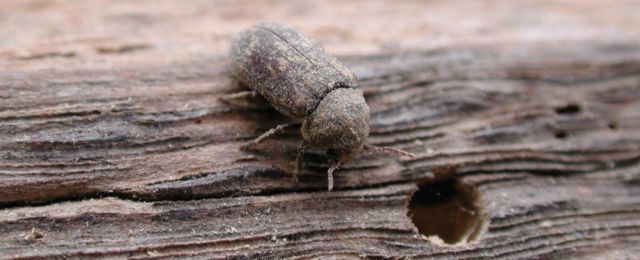
Deathwatch Beetle Lifecycle
Larvae will live for between 5 and 10 years or more, with larval tunnels much larger than the Common furniture beetle, causing much more damage. It will attack timber in older buildings that have been exposed to decay and infestation over a long timeframe.
Once fully grown, the larvae will pupate, before the adult beetle emerges through an exit hole in order to find a mate. It is at this point they will bang their head on timber and create a tapping ‘mating call.’
The adult female beetle has been known to lay up to 200 eggs, but the average is 40 to 60. These are ideally laid in cracks and crevices, while the eggs normally hatch after around a month.
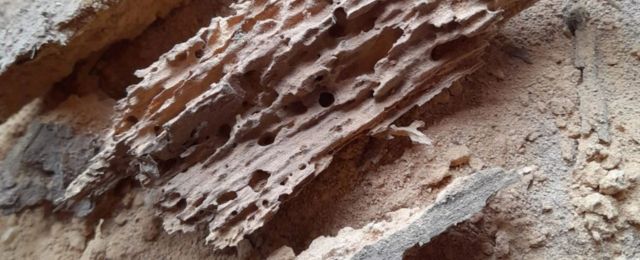
Deathwatch beetles can cause significant damage to decayed hardwood, as their tunnels and exit holes are larger than the Common Furniture beetle.
Woodboring Weevils
Woodboring Weevil (Pentarthrum huttoni, Euophryum confine and Euophryum rufum) are a type of beetle and consume decaying and damp timber, and are a common problem in properties in the UK. They are usually found in decayed softwoods and hardwoods that have a damp and fungal decay problem. So can often be found in rotten joists and floorboards that have been affected by either rising or penetrating damp, as well as under dripping sinks, baths or showers, around roof leaks or on damp sub-floor timbers.
The adult is 3 to 5mm long and is a black-brown colour and identifiable by its long rostrum (snout) on the end of which is its mouth. They will typically leave a 1mm diameter ragged exit hole, with larval tunnels and adult grazing following the direction of the grain, in a pattern known as ‘striations’.
Both adult and larvae consume decayed wood and therefore decay can be quite rapid all year round.
No insecticidal treatment is needed to stop a Woodboring weevil infestation - you must stop the source of damp (either from a leak, condensation, penetrating damp or rising damp) and once the timber dries out, the weevil infestation will be eradicated as the larvae die.
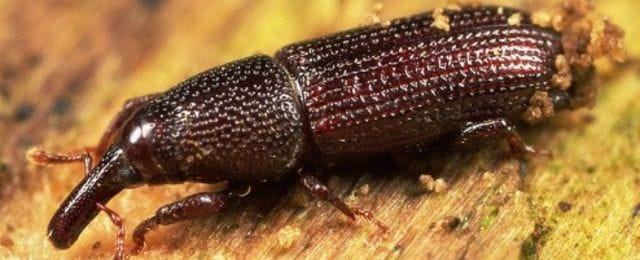
Woodboring Weevil Lifecycle
The female weevil will bite holes in timber and lay a single egg, before the larvae hatches and burrows into the damp timber. Around 25 eggs are known to be laid over 80 days, while the adult life span is around 16 months. They will consume damp timber and are common in timber affected by wet rot. If left, the associated problems caused by wet rot and Woodboring Weevil can lead to significant damage of structural timber.
Upon removing decayed skirting boards from a damp wall, it is very common to find large numbers of woodboring weevil scurrying away.
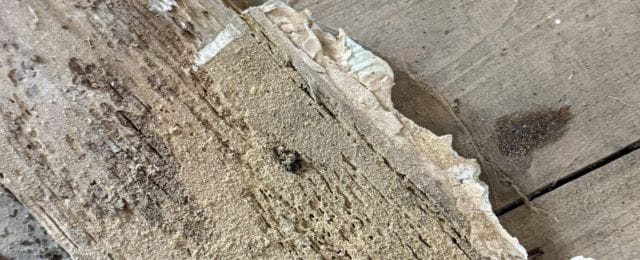
Weevil damage is ragged while tunnelling will follow the grain of the timber. Once the moisture source has been removed, the timber will dry and the Woodboring Weevil will no longer be able to sustain themselves.
House Longhorn Beetle
House Longhorn Beetle (Hylotrupes bajulus) is probably not native to the UK, originating in Europe, although it can now be found worldwide. It is mainly found in the South East of England, particularly in North West Surrey and around London. Its long established presence in Surrey has earned it the nickname of the 'Camberley Beetle'.
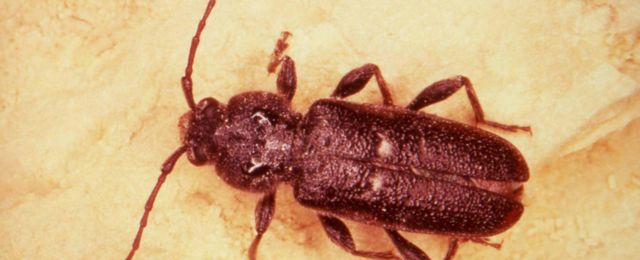
The adult beetle is between 7mm and 25mm in length and is a greyish brown to black colour, with grey-white spots on each wingcase. They have long curved antennae (long horns) which can be used to identify them.
Exit holes are oval and can be between 6-10mm in diameter on the long axis, whilst being 4-6mm on the short axis, making them much larger than the Common furniture beetle.
In the UK, they will attack the sapwood of most softwoods, but in Europe, they will attack some hardwoods. The moister and warmer the timber, the more severe the infestation. Hence roofing timbers are at greatest risk. The House longhorn beetle will emerge from timber during July to September, and will live for 3-4 weeks after pupation.
The adult female will use her ovipositor to lay 2-8 clutches of eggs in a fan shape within cracks on the surface of timber. They can lay as many as 500 eggs, but will typically average around 140-200 eggs during the mating season.
The larvae will bore long straight galleries within the sapwood and will typically consume timber from within for between 3 to 6 years. It only takes as little as six larvae to destroy a rafter, so flight holes are few and a thin skin of wood is often left on the outside until the tightly packed frass causes it to split.
Powderpost Beetle
Powder Post Beetle (Lyctus brunneus) is commonly found in Britain and will infest the starch rich sapwood of wide-pored hardwoods such as Oak, Ash, Elm and Walnut. It attacks these wide-pored hardwoods because the female beetle uses an egg laying tube (ovipositor) almost as long as its body, to insert up to three eggs down each end grain pore, protecting them from predation.
Timbers such as Beech, Birch and Horse Chestnut have pores which are too small in diameter and are therefore rarely attacked by the Powder Post Beetle. Some species of powderpost will also readily attack items made from wicker, such as hampers and linen baskets, which are entirely made of sapwood.
Imported ply and laminate often uses fast grown hardwoods containing a high proportion of sapwood, so these can bring in powderpost infestations. Softwoods such as pine cannot be infested as the pores are mostly too small and they contain little to no starch.
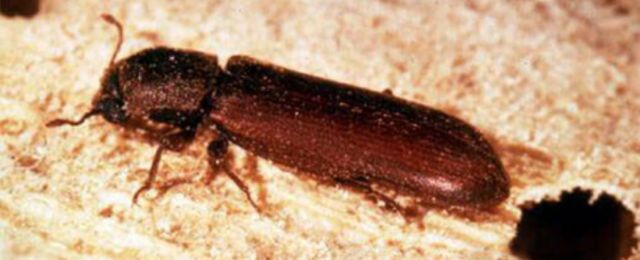
The adult beetle is between 2mm and 7mm in length, and is dark to reddish-brown in colour. Powder Post beetle will create exit holes which are around 1mm-2mm in diameter.
The larvae will primarily damage the sapwood, leaving behind powdery frass on the surface. The life cycle is around one year, so damage can be quite rapid. It is more common in timber yards than homes, but is increasingly found in imported wood products and laminate flooring layers.
Forest Longhorn Beetle
There are more than sixty species of forest longhorn beetle infesting both softwoods and hardwoods in the wild in the UK. In general appearance they all share features of House Longhorn beetle, but they can be very colourful.
The lifecycle generally ends with the larva dying as the timber dries after felling or with an adult beetle emerging from a finished product. It is very unlikely that any of these beetles will find suitable timber to infest in a property as both climatic and timber conditions are unsuitable, as they normally start out life in decayed living trees or recently felled timber.
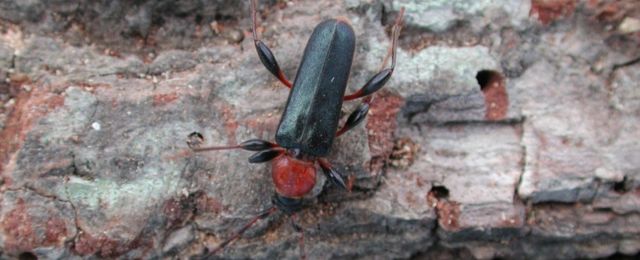
A commonly occurring UK species is Oak Longhorn beetle or Tanbark bore (Phymatodes testaceus) which as the name suggests, infests the bark and cambium of oak logs and dead standing timber, although other tree species may be affected. The adult beetles are 8mm-13mm long and very variable in colour. The common forms are light brown all over and a red thorax with deep blue-black elytra.
Lifecycles of Forest Longhorn beetles vary between two and six years, and when the larvae emerge they will produce a large elliptical to banana shaped exit hole. Sometimes the bark falls off due to tunnelling of the larvae and then the extensive damage can be seen.
They are commonly found when logs with bark are brought into a property for use in fires during winter, but not used. In the late winter or spring, the householder will think mice are in the fireplace due to the scurrying, but closer inspection will reveal the large beetles emerging due to the warmth. Large numbers of beetles may be found on window sills. All that is required is to remove the infected logs outside, together with the beetles, as internal timbers are not at risk.
Pine Bark Borer and Bark Beetles
Pine Bark borer (Ernobius mollis) is related to Common furniture and Deathwatch beetle. It will only infest the bark of softwoods, and can sometimes be found in timbers which still have bark adhered to it in vernacular or historic properties.
The female beetle will wedge eggs into crevices in the bark and when the eggs hatch the larvae bore away inside the bark and outer ring of sapwood. The large number of larvae may cause the bark to fall off. Frass is bun shaped and the colour varies from dark to pale, depending on what they have bored through. Adult beetles emerge June to August and leave a small round flight hole in the bark.
Similar to Woodboring weevil, treatment is not normally required. If the bark is removed from the affected timbers, the infestation will die out. It should also be remembered that bark is waterproof and water based insecticides will not soak in.
Bark beetles belong to an entirely different family to Pine Bark borer, but the lifecycle is very similar. There are 66 members of the true Bark beetles found in the UK and they tend to be quite “dumpy” beetles with large clubs on the end of their antenna. The most famous Bark beetle in the UK is Scolytus which spreads the fungal spores that cause Dutch Elm disease.
Because the larvae of Bark beetles develop within or under the bark of dead or living trees, they are one of the most important pests of commercially grown timber. Many however only attack trees already weakened by disease. Within this group are a small number of species that infest bark in dead or dying trees and felled logs. It is in this way that they may be brought into the home.
Females will generally bore an entry hole into the bark and down into the cambium layer, where they lay eggs at regular intervals along the tunnel wall. When the larvae emerge, they bore along the cambium in a particular pattern. This means that particular species have a pattern as distinctive as a fingerprint and if the bark is peeled off a log, the infesting species can be identified long after it has departed.
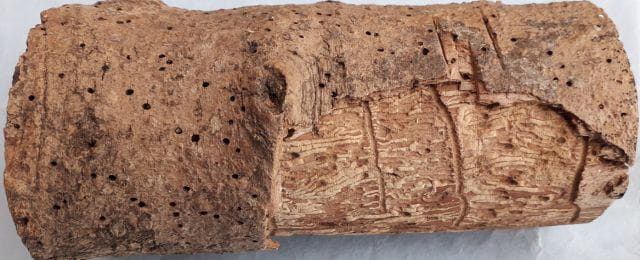
In many species, emergence of adults through the bark is synchronised, such that hundreds can emerge in a short space of time and be attracted to light. This normally prompts concern from the householder. All that is required is to remove the infected logs outside, together with the beetles, as internal timbers are not at risk and few if any larvae will remain in the logs.
In the UK, the most common call out to properties is for Ash bark beetle emergence (Hylesinus varius).
Ash bark beetles are 3mm long and dumpy with a mottled dark and light brown pattern on the wing cases. They have clubbed antennas and fly with ease. In the South there are two broods a year, but in the North, one. Peeling back the bark on suspect logs will reveal the distinctive larval tunnel pattern.
They have become a common concern for householders since the increase in popularity of open fires and log burners, plus the availability of ash logs as a result of ash dieback fungus.
Noticed Woodworm Beetles in your property? Next Steps
If you have spotted live woodworm beetles in your property and are worried about what to do next, you may require specialist advice from a professional surveyor.
Further investigation may be required in order to identify other signs of an active woodworm infestation, and if any structural timbers have lost load capacity, thereby risking collapse.
The qualified surveyor will be able to provide advice on whether or not the woodworm infestation is active or not, and if so, if treatments are required.
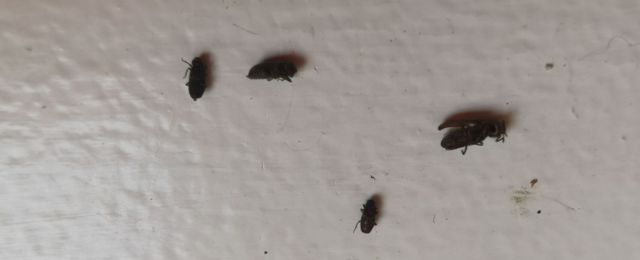
Dead or live beetles may be spotted in your property, typically near windows as they fly towards the light. Identification and further investigation may be required to identify the source of the woodworm problem.
Woodworm Survey
A woodworm survey, sometimes referred to as a damp and timber survey, is carried out by a CSRT or CSTDB qualified surveyor, and is used to confirm whether or not a woodworm infestation is active, and if treatment is necessary.
They will carry out a thorough inspection of timber to understand the extent of the woodworm issue, the type of species involved and will confirm the treatment plan, including the use of insecticidal treatments and timber repairs.
A detailed inspection of a suspected woodworm infestation is crucial as different beetles may require different treatments, and the problem can often be hidden from sight. In some cases, our surveyor may need to lift floorboards or access roof voids to fully investigate the affected area. The surveyor will provide you with an easy to understand survey report, outlining their findings, and only if required, recommendations for treatments.
Rentokil Property Care have a number of PCA qualified surveyors who can help provide you with answers and long term solutions.
Why Rentokil Property Care?
Rentokil Property Care are experts in woodworm and timber solutions, and have been offering professional solutions for decades.
We provide help to homeowners, social housing providers and commercial clients across the country with personalised advice for woodworm infestations.
PCA approved: Rentokil Property Care are a proud founder member of the PCA and have a range of CSTDB, CSRT and CSSW qualified surveyors operating out of our network of local branches.
Which? Trusted Trader: We are endorsed by Which? Trusted Trader - meaning our customer service and workmanship has passed the rigorous trading standards assessments.
Trustpilot: Our damp proofing, structural repairs and timber treatments are rated ‘Excellent’ with over 1,000 reviews from our customers - showcasing our professionalism.
Long Term Commitment: From our origins in the 1920’s to the present day, we have outlived our guarantees several times over. This means you can have complete peace of mind from a Rentokil Property Care guarantee - up to 30 years for some of our services.